READ A FREE SAMPLE
Discover how experience changes the brain, shapes behavior, and opens the way to transformation.
BEFORE YOU BEGIN
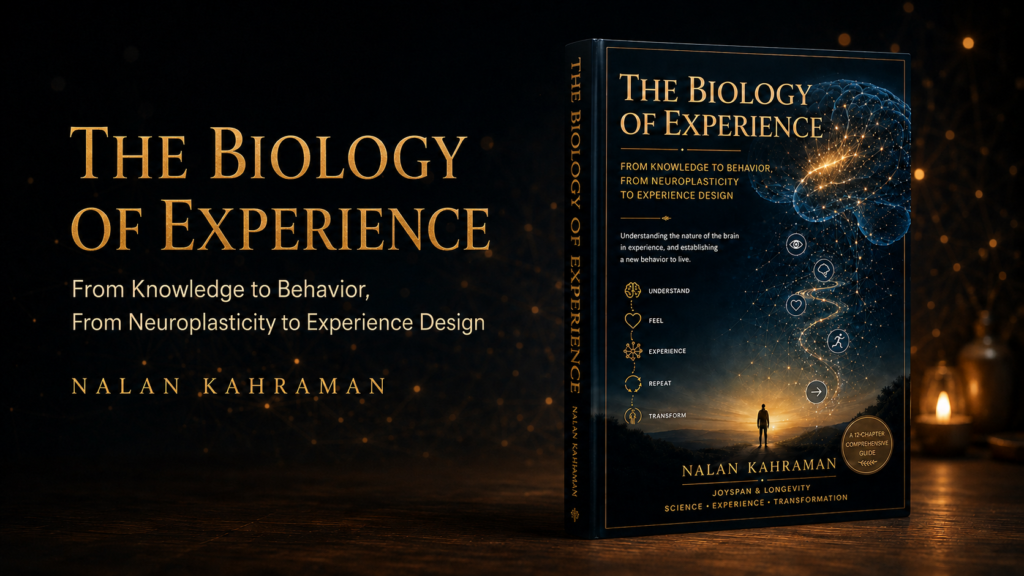
The Biology of Experience explores what happens between an event and the behavior that follows.
This free sample introduces the book’s central perspective and invites you to observe how experience moves through the brain, nervous system, thought, emotion, and daily life.
AUTHOR’S NOTE
Since childhood, there has been something about human behavior that has held my attention: sometimes, a surprisingly wide gap appears between what people say about themselves and what they do in real moments of life.
A person describes themselves as calm, then begins trying to take control at the slightest uncertainty. They say, “I don’t care about this,” yet their body, thoughts, and behaviors continue to revolve around the event for days. They say they know exactly what they want, but when the moment of choice arrives, they move in another direction. They say they will no longer repeat a certain behavior, then find themselves doing the same thing when a similar situation arises.
For many years, these contradictions kept the same question alive in me:
How does this gap emerge between what people say about themselves and the behaviors that appear in their lives?
Over time, another question joined it:
When does an event we experience truly end?
A conversation ends, an argument is closed, a decision is made, or a bodily feeling lasting only a few seconds passes. From the outside, the event appears complete. Yet when we look at the movements of the body, nervous system, thoughts, and emotions, we see that its effects continue in different forms.
Sometimes an event becomes an expectation. Sometimes it leaves a familiar movement in the body. Sometimes it creates a pathway that thought uses again and again. At other times, it becomes part of a behavioral tendency that quickly emerges during the next encounter. In this way, an event we believe belongs to the past continues to live within the system entering the next experience.
İnsanlar kendilerini anlatırken çoğu zaman ne düşündüklerinden, neye inandıklarından, ne istediklerinden ve nasıl biri olduklarından söz ederler. Ancak gerçek yaşamda davranış yalnızca bu anlatıdan doğmaz. O anda bedenin içinde bulunduğu durum, sinir sisteminin geçmiş deneyimlerden öğrendikleri, tanıdık düşünceler, oluşan duygu ve daha önce sonuç üretmiş davranış yolları da yaşananlara katılır.
Belki de bu nedenle insan kendisini çok iyi tanıdığı hâlde kendi davranışı karşısında şaşırabilir:
“Bunu neden yaptım?”
“Böyle sonuçlanacağını biliyordum.”
“This isn’t who I really am.”
“I said I wouldn’t do it again.”
Behind these statements lies, in my view, something far more interesting than inconsistency within the person: the relationship between the known self and the system operating within life.
The Biology of Experience emerged from my pursuit of this relationship.
In this book, instead of viewing the difference between what a person says and what they do as a matter of character, I explore how behavior forms. I follow what the body perceives when we encounter an event, what learning the nervous system carries from past experiences, where thought and emotion arise within this process, how behavior emerges, and what the outcome of that behavior carries into the next experience.
The questions I have long asked about human behavior remain with me today; they have simply become more detailed:
Under what conditions do people carry what they know, think, and say about themselves into their behavior, and under what conditions does a previously learned pattern take over?
This book is an inquiry that follows that question.
The Biology of Experience emerged precisely from my effort to understand this movement. How is an experience processed within a person? What does the body perceive at that moment? What does thought do? How does emotion form? Under what conditions does behavior emerge, and how does the outcome of that behavior return to the system? More importantly, what does everything that occurs change in the next experience?
I began by observing and studying this process within myself. After many experiences that left me astonished and at times unable to believe what I was seeing, I began looking more deeply and observing other people as well.
As I explored these questions, I began to see more clearly why understanding oneself is not always enough. A person may understand why a behavior keeps recurring, know what they want to do differently, and even describe very clearly how they intend to respond when a similar event occurs. They create long lists of things they declare they will never do again. Then real life appears. A word, a silence, an unexpected response, a familiar bodily feeling, or a powerful emotion arises, and the person may find themselves once again inside the old behavior they know so well.
This became the point that interested me most, because the issue extended beyond the gap between knowledge and practice. A much broader system was operating simultaneously within the experience. The body continually gathers data. Thought processes this data together with previous experiences and generates possibilities. The emotional state changes the quality of the experience. Previously learned behaviors become accessible again with varying degrees of strength, and in that moment, the person produces a behavior. The behavior then creates an outcome. That outcome is perceived once again by the body and nervous system as new data.
Behavior itself initiates a new experience.
When we do something differently, a change occurs in our environment. The person before us responds differently, our body shifts into another state, what we expected may diverge from what actually happens, and our thoughts and emotions may be reshaped. The nervous system uses all this new data to prepare for the next encounter. Every experience, therefore, can create changes—small or large—so that we do not enter the next one with exactly the same system.
As I explored these questions, I began to see more clearly why understanding oneself is not always enough. A person may understand why a behavior keeps recurring, know what they want to do differently, and even describe very clearly how they intend to respond when a similar event occurs. They create long lists of things they declare they will never do again. Then real life appears. A word, a silence, an unexpected response, a familiar bodily feeling, or a powerful emotion arises, and the person may find themselves once again inside the old behavior they know so well.
This became the point that interested me most, because the issue extended beyond the gap between knowledge and practice. A much broader system was operating simultaneously within the experience. The body continually gathers data. Thought processes this data together with previous experiences and generates possibilities. The emotional state changes the quality of the experience. Previously learned behaviors become accessible again with varying degrees of strength, and in that moment, the person produces a behavior. The behavior then creates an outcome. That outcome is perceived once again by the body and nervous system as new data.
This inquiry led me to neuroplasticity, neural networks, synapses, learning, memory, interoception, habits, dopamine systems, sleep, and consolidation. As I continued, however, I saw that discussing behavioral change through the brain alone left part of the picture incomplete. The brain is not the only participant in experience. There is the body, feeling, thought, emotion, behavior, the outcome created by that behavior, and the perception of all these elements once again.
For this reason, rather than explaining these mechanisms separately, this book seeks to understand how they come together within experience.
How does a person truly experience a new behavior, and how does that experience become an accessible part of their life over time?
Awareness has an important place here. Becoming aware of a behavior can open the door to change, but opening that door and actually living a new behavior are not the same thing. Seeing the old behavioral tendency is one process. Choosing another movement while that tendency remains powerful is another. Experiencing the outcome of that movement is another still. The integration of the new data created by this outcome—in the body, thought, and emotion—is yet another process.
Throughout this book, therefore, I do not examine change solely by asking, “Has the old behavior disappeared?” The return of an old behavior may not mean that new learning has been erased. Sometimes change becomes visible in noticing the behavior sooner. Sometimes it appears in remaining within it for less time or moving toward another option more quickly. At other times, the same bodily feeling, thought, or emotion is still present, yet the person is now able to move through it differently.
For me, the most interesting dimension of learning begins here. The nervous system continually processes data from within the body and from the surrounding environment, contributing to the organism’s survival and adaptation to changing conditions. It learns more than what we do. It also learns what we do under particular conditions, what happens afterward, and what the outcome means for the system. Over time, this learning contributes to which situations become more familiar, which conditions are perceived in the direction of threat or safety, and which behaviors become more accessible.
New data emerges when a behavior produces the outcome we want, and also when it does not. The reappearance of an old behavior is data. A new behavior that once felt difficult becoming easier in another encounter is also data. In every experience, the system records more than the outcome; it also learns the relationship between the behavior and its result.
Learning, therefore, does not progress solely through finding the correct answer. Each time a person encounters life, they experience a new outcome, and that outcome becomes part of the data available to the system. As experience expands, the behavioral pathways available to the system in response to the same event can expand as well.
“Learning does not progress solely through finding the correct answer; it progresses through encountering life and expanding the behavioral possibilities available to the system.”
For this reason, I approach the book’s central movement as a continually interacting cycle rather than a single linear formula: experience affects behavior, behavior produces an outcome, the outcome provides new data, new data participates in learning, and learning changes the system that enters the next experience. Sometimes this change is immediately noticeable. At other times, it becomes visible only after time has passed. Sleep, rest, repetition, encountering the experience again in different contexts, and the new behavior gradually requiring less conscious attention are all part of this integration.
This is why the book ultimately arrives at experience design. I do not view experience design as a method for directing a person toward a predetermined outcome. Nor do I seek to create a structure that tells someone how they should feel, what they should think, or how they should behave.
For me, experience design is a field of inquiry that makes visible the conditions in which people can see their own experience more clearly, recognize their existing behavioral tendencies, and genuinely live new behavioral possibilities.
The aim here is not to continually correct oneself or to turn self-observation into an exhausting task. It is more about looking a little more closely at what is already happening within life: What happened? What moved in my body? What did I think, feel, and do? What happened next, and what new data did this experience give me that I did not have before?
Sometimes development becomes visible in the moment of a major decision. Sometimes it begins by waiting just one second longer, responding differently for the first time, allowing a bodily feeling to remain unexplained for a moment, or recognizing that a thought may be a prediction rather than reality. A new behavior experienced once may appear to be a small deviation. Through repetition, it becomes more accessible. When it can be used under different conditions, it becomes part of the behavioral repertoire. As it begins to require less conscious attention over time, it ceases to be merely a “new behavior” and becomes one of life’s natural movements.
Perhaps this is the most fundamental possibility the book pursues: when life brings us a similar event again, a familiar movement may begin in the body, the old thought may return, and the same emotion may arise—yet despite all this, we recognize that we can now behave differently.
“I would have responded differently here in the past.”
Nalan Kahraman
Kuşadası, 2026
CONTENTS
I. HOW DOES EXPERIENCE CHANGE THE BRAIN?
Chapter 1 — Can the Brain Change?
Neural Networks, Experience, and Neuroplasticity
Chapter 2 — How Does an Experience Leave a Trace in the Brain?
Synapses, Learning, and the Neural Trace of Experience
II. WHAT HAPPENS WITHIN AN EXPERIENCE?
Chapter 3 — Where Do Feeling, Thought, Emotion, and Behavior Meet in the Brain?
The Wholeness of Experience: From Bodily Data to Behavior
Chapter 4 — The Same Stimulus, a Different Behavior: Where Does Change Begin?
Conscious Choice and the Possibility of New Behavior
Chapter 5 — Is Noticing Enough?
How Does a New Behavior Become Integrated into the Nervous System?
CHAPTER 1
CAN THE BRAIN CHANGE?
Neural Networks, Experience, and Neuroplasticity
We learn something. We understand what we need to do. Sometimes we can even explain ourselves, our behaviors, and why we repeatedly do the same things when faced with similar events. Then a real event occurs in life, and once again, we find ourselves inside the old behavior we know so well.
This encounter opens an important question:
What happens between understanding something and that understanding changing our behavior in life?
It is difficult to answer this question by looking only at the final moment when the behavior emerges. The state of the body, learning carried by the nervous system from previous experiences, the neural pathways being used, thoughts, emotions, and outcomes experienced in similar situations all contribute to the formation of that behavior.
As we seek to understand a behavior, we will therefore add other questions to “Why did I do this again?” What did this event activate within me? Which previous learning did my system carry into this encounter? What happened after the behavior emerged, and what new data did that outcome add to the system?
These questions lead us to one of the most important characteristics of the brain and nervous system: neuroplasticity.
WHAT DOES NEUROPLASTICITY MEAN?
In its broadest sense, the word “plasticity” describes a structure’s ability to change its form in response to the influences acting upon it and to retain at least part of that change after the influence has ended. In relation to the nervous system, neuroplasticity is the capacity of the brain and nervous system to change their connections and ways of functioning in response to experience, learning, environmental conditions, and use.
We can think of the brain as a living system that continually reorganizes itself through experience throughout life. When an experience occurs, particular groups of neurons become active, connections are used, and networks work together. This use contributes to the future activity of those connections: some grow stronger, others become less influential, new connections form, and the way networks work together is reorganized.
Experience thus becomes a biological movement broader than an event that occurred and ended in the past. What was lived becomes one of the operating conditions of the nervous system entering the next encounter.
.
As the brain records life, it also changes its own way of functioning through what it experiences.
WHAT IS A NEURON, AND WHAT IS A NEURAL NETWORK?
When we say “the brain changes,” we are not referring to an abstract whole. A significant part of this change occurs in the connections between nerve cells and in the networks formed by those connections. To see how experience influences behavior, we first need to move closer to one of this structure’s fundamental elements: the neuron.
A neuron is a nerve cell that receives information, processes it, and transmits signals to other cells within the nervous system. The brain contains billions of neurons, yet complex processes such as thought, memory, emotion, and behavior cannot be explained through the activity of a single neuron. Neurons form connections with one another, become active together as parts of extensive networks, and carry information through electrical and chemical processes within those networks.
A neuron receives signals from other cells, integrates them within its own functioning, and influences other cells through its activity. When we speak of a neuron network or neural network, we are referring to many interconnected nerve cells that work together during particular functions.
We can compare this to the transportation network of a large city. A city is not formed by a single street; streets, intersections, major roads, side roads, and the relationships among them collectively create a transportation system. In a similar way, neurons in the brain work in connection with one another within broader networks.
For communication to occur within this network, activity in one neuron must influence another cell. This communication between two cells brings us to the synapse.
WHAT IS A SYNAPSE?
A synapse is the connection site through which a nerve cell transmits information to another cell. The second cell may be another neuron, a muscle cell, or a gland cell. We can think of the synapse as the transition zone where communication between two cells occurs.
At most chemical synapses, there is a very small gap between the cells. When electrical activity in a neuron reaches the connection site, it triggers the release of chemical messengers, which then affect the activity of the receiving cell.
What matters for us is that this communication does not continue operating in exactly the same way over time. Experience and use can change the effectiveness of the connection between two cells. Some connections grow stronger, while others become less influential. These changes in synapses, shaped by experience and patterns of activity, are studied under the heading of synaptic plasticity.
We therefore see one dimension of neuroplasticity through changes in how cells communicate with one another. Now let us bring this biological movement into an encounter from everyday life.
CONTINUE THE EXPERIENCE
The journey from neural connections to behavior, learning, and experience design continues in the full book.

STAY CONNECTED
Stay connected for new books, research, publications, and individual sessions.
Instagram
@nalan_kahraman
YouTube
@NalanKahramana
Website
nalankahraman.com
WhatsApp
+90 534 249 53 50
Email
nalankahraman@hotmail.com
a.nalankahraman@gmail.com
Contact
Get in touch to send a message.